TDEE Calculator: Understanding Your Total Daily Energy Expenditure in 2026
Did you know that research from 2024 indicates nearly 65% of UK adults fail to reach their fitness goals because they rely on generic calorie estimates rather than personalised data? It's exhausting to hit a weight loss …

In this guide
Did you know that research from 2024 indicates nearly 65% of UK adults fail to reach their fitness goals because they rely on generic calorie estimates rather than personalised data? It's exhausting to hit a weight loss plateau when you feel like you're doing everything right. You've likely experienced the frustration of "one-size-fits-all" diet plans that simply don't account for your unique biology. We understand that this confusion often leads to burnout, but the solution lies in clinical accuracy rather than guesswork.
By using a professional tdee calculator, you'll finally uncover the precise number of calories your body burns every single day. This article will help you master your metabolic data to fuel a safe, medically-informed journey toward your ideal weight. We'll explore the vital differences between BMR and TDEE, provide you with a clear daily target, and explain when seeking expert medical weight loss support is the most effective next step for your long-term health.
Key Takeaways
- Distinguish between your Basal Metabolic Rate and your total daily expenditure to understand the true foundation of your metabolism.
- Use a tdee calculator to establish a precise calorie baseline, allowing you to create a sustainable deficit for safe and effective weight loss.
- Identify the four primary pillars of energy burn and learn how your activity levels and diet impact your daily caloric requirements.
- Learn why weight loss progress often stalls and how to adjust your plan to account for metabolic adaptation as you reach your goals.
- Discover when clinical support is necessary and how modern medications like Wegovy or Mounjaro can help overcome biological barriers to weight loss.
What is TDEE and Why is it the Foundation of Weight Loss?
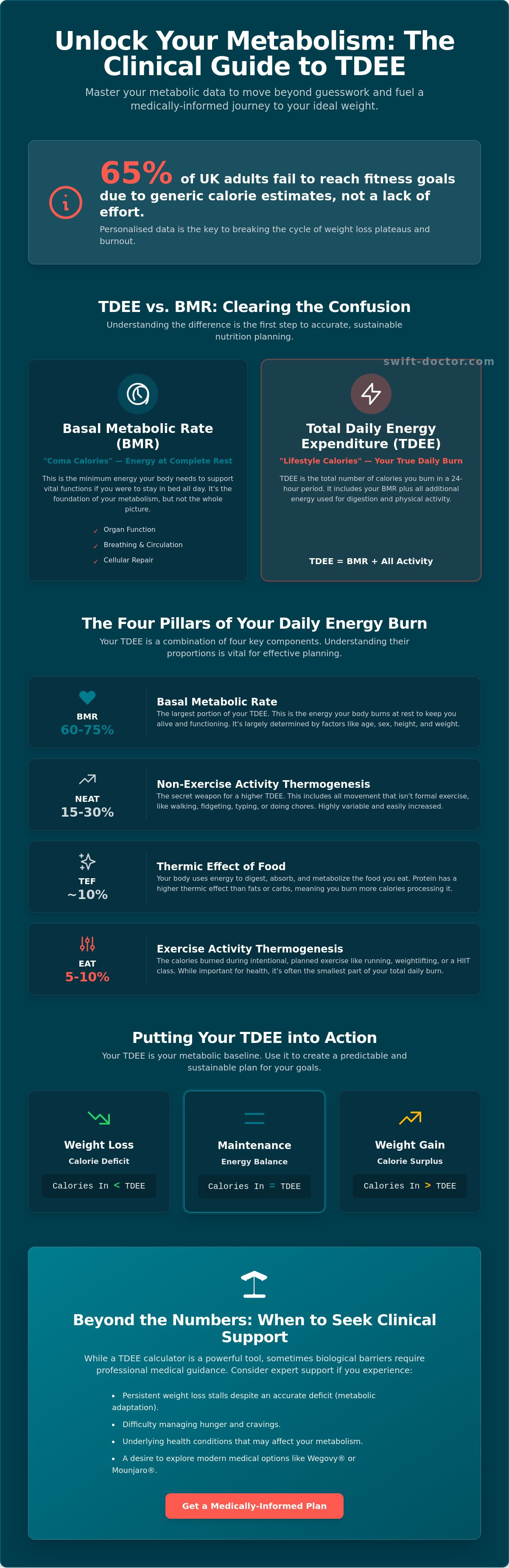
Total Daily Energy Expenditure (TDEE) represents the cumulative number of calories your body burns over a full 24-hour period. It's not just a measure of how hard you train at the gym; it encompasses every physiological process from cellular repair to walking the dog. Understanding What is TDEE provides the necessary context for how our bodies utilize fuel. In 2026, weight management has shifted away from generic calorie counting toward this personalised metabolic profile. Using a tdee calculator allows you to move past guesswork and establish a clear biological starting point for your health journey.
Energy balance is the clinical relationship between the energy you consume through food and the energy your body expends. If consumption matches expenditure, your weight remains stable. If you consume less than your TDEE, a deficit occurs, leading to weight loss. This isn't about willpower or restriction; it's a matter of physiological accounting. We view this balance as a diagnostic tool rather than a source of pressure, helping you understand how your lifestyle choices translate into metabolic data.
The Role of TDEE in Modern Clinical Nutrition
UK clinicians and private nutritionists now prioritise TDEE over traditional BMI metrics because it accounts for individual activity levels. In 2026, accurate baseline data is considered the first step in any safe clinical intervention. Without knowing your maintenance calories, any prescribed deficit could be too aggressive, potentially leading to muscle loss or hormonal disruption. TDEE is the metabolic baseline for all weight-loss interventions. By establishing this figure, healthcare providers can ensure that nutritional plans are both effective and biologically sustainable for the patient's specific routine.
TDEE vs. BMR: Clearing the Confusion
Many people mistakenly use these terms interchangeably, but they represent very different physiological states. Confusing the two often leads to individuals eating far too little, which triggers fatigue and metabolic slowdown. A tdee calculator helps distinguish these figures to keep your nutrition on track. Here are the primary differences:
- Basal Metabolic Rate (BMR): Often called "coma calories," this is the energy required to keep your organs functioning, your heart beating, and your brain active while at total rest.
- Total Daily Energy Expenditure (TDEE): This represents your "lifestyle calories." It includes your BMR plus the Thermic Effect of Food (digestion) and all physical movement, whether that's a HIIT session or just typing at your desk.
Relying solely on BMR for weight loss targets is a common error. Since BMR only covers basic survival, eating at this level while maintaining a busy UK lifestyle creates an unsustainable deficit. TDEE provides a more realistic reflection of your actual needs, ensuring you have enough energy for both your daily responsibilities and your long-term health goals. It's the difference between surviving and thriving while you work toward a healthier weight.
The Four Pillars of Your Total Daily Energy Expenditure
Your body is a complex biological engine that never truly stops. To manage your weight or health goals effectively, you must understand The Four Pillars of Your Total Daily Energy Expenditure. These components dictate how many calories you burn every 24 hours. The largest portion is your Basal Metabolic Rate (BMR). This covers 60% to 75% of your total burn. This energy keeps your heart beating, brain functioning, and lungs breathing while you rest. Beyond this base, your daily movement and diet determine the final number you see on a tdee calculator.
Exercise Activity Thermogenesis (EAT) is the most visible pillar, yet it's often the smallest. For most people, planned workouts only account for 5% to 10% of their total daily burn. Relying solely on the gym to create a deficit is a common mistake. Instead, focusing on the broader spectrum of metabolic pillars provides a more reliable path to long-term health and weight management.
Understanding NEAT: The Secret to a Higher TDEE
Non-Exercise Activity Thermogenesis (NEAT) includes all movement that isn't intentional exercise. This includes walking to the bus stop, typing, or even fidgeting. For many in the UK, sedentary desk jobs are a major hurdle to metabolic health. Recent data shows that the average UK office worker sits for 9 hours a day. This lack of movement can lower your daily burn by hundreds of calories compared to an active individual. Increasing NEAT is often more sustainable than adding intense gym sessions. Choosing the stairs over the lift or taking a 15 minute walk during a lunch break can shift your metabolic balance. If you're struggling with persistent fatigue while trying to stay active, a private GP consultation can help identify any underlying health barriers or nutritional deficiencies.
The Thermic Effect of Food: Why Macros Matter
The Thermic Effect of Food (TEF) represents the energy required to digest, absorb, and process nutrients. While a calorie is a unit of energy, different macronutrients have different metabolic costs. Protein is the most "expensive" for your body to process. It has a TEF of 20% to 30%. This means your body burns nearly a third of the protein's calories just to digest it. In contrast, fats have a TEF of only 0% to 3%. A protein-rich diet subtly boosts your tdee calculator results by increasing this internal heat production. Carbohydrates sit in the middle with a TEF of 5% to 10%. Prioritising lean proteins ensures your metabolism works harder during every meal, improving metabolic efficiency over time.
- BMR: 60-75% of daily energy expenditure for basic survival.
- TEF: Energy used for digestion, roughly 10% of total daily intake.
- NEAT: Spontaneous movement, which varies significantly based on lifestyle.
- EAT: Planned exercise, often the smallest contributor for the average person.
Why Your TDEE Calculation Might Feel 'Broken'
Many patients feel a deep sense of frustration when their progress stalls despite following their numbers perfectly. You might have used a tdee calculator, set a 500-calorie deficit, and yet the scale hasn't moved for 21 days. This doesn't mean the laws of thermodynamics have failed. Instead, it usually points to a gap between algorithmic predictions and biological reality. The most frequent issue is the overestimation of activity levels. Research published in the Journal of Sports Sciences shows that individuals often overestimate their exercise intensity by up to 50% while simultaneously underestimating their calorie intake by roughly 30%.
Standard formulas also have inherent limitations. Most tools use the Mifflin-St Jeor equation, which is excellent for the general population but lacks nuance regarding body composition. If you carry significant muscle mass, the Katch-McArdle formula is often more appropriate because it prioritises lean body mass. When these variables aren't aligned, your starting point is flawed from day one.
Metabolic Adaptation and the Weight Loss Plateau
Your body is a dynamic system, not a static calculator. A TDEE calculated at 100kg will not remain accurate once you reach 80kg. A smaller body requires less energy to move and maintain its vital functions. Beyond simple physics, your body employs a survival mechanism called adaptive thermogenesis. This process lowers your resting metabolic rate during prolonged periods of calorie restriction to prevent what it perceives as starvation.
- The Weight Factor: Losing 10% of your body weight can lead to a disproportionate drop in metabolic rate, sometimes 15% lower than predicted.
- The Plateau: A true plateau is defined by four consecutive weeks without change in weight or body measurements.
- Water Retention: Stress and high cortisol levels can cause the body to hold 1kg to 2kg of water, masking fat loss on the scale.
Accuracy Issues: Wearables vs. Calculators
It's tempting to rely on smartwatches to track "calories burned," but these devices often provide a false sense of precision. A 2017 study from Stanford University highlighted that even the most popular fitness trackers showed a margin of error between 27% and 93% for energy expenditure. These devices are helpful for tracking trends, but they aren't clinical instruments. Understanding How to Use Your TDEE involves viewing the initial number as a flexible baseline rather than a definitive law. Use the tdee calculator as your starting point, but adjust your intake based on real-world results. Clinical observation always trumps algorithmic estimation. If your weight doesn't change over a month, you must lower your intake or increase your movement, regardless of what the screen says.
How to Use Your TDEE to Create a Sustainable Plan
Transforming data into a practical health strategy requires a methodical approach. Your tdee calculator result serves as your baseline, but real progress happens through consistent application and monitoring. Follow these clinical steps to build a plan that works for your biology:
- Calculate your baseline: Input your current weight and a realistic assessment of your movement. Honesty about your activity level ensures the starting figure is accurate.
- Define the deficit: Subtract 500 kcal from your total expenditure. This creates a theoretical weight loss of roughly 0.5kg per week, which is manageable for most adults without triggering extreme hunger.
- Establish a trial period: Follow your new target for 14 to 21 days. Don't change your calorie intake or exercise routine during this window so you can gather clean data on how your body responds.
- Analyze and adapt: If the scale hasn't moved after three weeks, reduce your intake by another 100 to 200 kcal. If you feel lethargic or your sleep quality drops, you may need to increase it slightly.
- Update your metrics: Your energy needs drop as you lose body mass. Re-calculate your TDEE every 5kg of weight lost to ensure your deficit remains effective and your progress doesn't stall.
Setting a Safe Deficit in Line with UK Health Standards
Rapid weight loss often leads to muscle wastage and nutrient deficiencies. UK clinical guidelines suggest a steady loss of 0.5kg to 1kg per week is the gold standard for long-term health. Crash dieting or Very Low Calorie Diets (VLCDs) can trigger metabolic adaptation, making it significantly harder to maintain results later. Focus on nutrient density by prioritising lean proteins and fibrous vegetables to stay satiated while staying within your calculated limits.
Adjusting Activity Levels Without Burning Out
Many people overestimate their physical exertion. If you work a desk job, selecting "Sedentary" on the tdee calculator is usually the safest starting point, even if you hit the gym for an hour three times a week. Avoid the common trap of "eating back" calories burned during exercise. Fitness trackers can overstate expenditure by up to 40% in some cases. Instead, use resistance training to preserve lean muscle mass. This keeps your basal metabolic rate higher, making your weight management journey more efficient over time. If you need professional guidance on managing your metabolic health or weight, you can book a private consultation for personalised medical support.
Beyond the Numbers: When Clinical Support is Necessary
A tdee calculator provides a precise mathematical roadmap for weight loss, but the human body isn't always a simple machine. For many people in the UK, maintaining a consistent calorie deficit feels like an impossible battle against their own biology. Factors like insulin resistance, hormonal shifts, and metabolic adaptation can make sticking to a calculated deficit physically and mentally draining. When the numbers on your tracking app don't translate into results on the scale, it's often a sign that biological hurdles are at play.
Clinical treatments like Mounjaro and Wegovy act as powerful tools to bridge this gap. These GLP-1 medications help regulate insulin response and slow gastric emptying, which directly impacts how you feel after eating. Instead of relying solely on willpower, these treatments help you adhere to the deficit your tdee calculator suggests by making satiety a physical reality rather than a mental struggle. This medical support turns a difficult journey into a manageable process by addressing the root causes of overeating and metabolic dysfunction.
The Synergy of TDEE Tracking and Mounjaro
One of the most significant benefits of Mounjaro is its ability to silence "food noise." This refers to the constant, intrusive thoughts about food that make it difficult to hit your caloric targets. When this noise is gone, the targets set by your tdee calculator become much easier to reach. You stop fighting your body and start working with it.
While on weight loss injections, monitoring your protein intake is vital. Rapid weight loss can sometimes lead to the loss of muscle mass, which can lower your basal metabolic rate. Our GMC-registered doctors provide the oversight needed to ensure your weight loss is healthy and sustainable. They help you navigate your metabolic journey, ensuring you maintain lean muscle while losing fat, which keeps your metabolism functioning efficiently in the long term.
Starting Your Journey with SwiftDoctor
SwiftDoctor provides a professional and modern approach to weight management, combining clinical expertise with the convenience of digital healthcare. You can access a regulated online consultation from the comfort of your home, avoiding the need for travel or long waiting room times. Our process is designed to be quick, discreet, and patient-focused.
Safety is the cornerstone of our service. All medications are dispensed by a GPhC-registered pharmacy, ensuring that you receive genuine, regulated treatments. We offer a secure environment where you can seek help without judgment, backed by the reliability of UK medical standards. If you're ready to move beyond simple calculations and address the biological factors holding you back, we're here to help.
Start your clinical weight loss consultation today at SwiftDoctor and take a decisive step toward reaching your health goals with professional medical support.
Mastering Your Metabolism for Sustainable Progress
Understanding your daily energy needs is the first step toward effective weight management. While a tdee calculator provides a vital baseline, your metabolism is a dynamic system. Factors like your thermic effect of food and non-exercise activity mean your requirements shift based on daily habits. If you've found that tracking numbers alone isn't delivering the results you expected, it's often because biological hurdles require a professional clinical approach.
Achieving your health goals often requires more than just a calorie deficit. Swift Doctor offers a path forward through a GMC-registered medical review process. We specialise in evidence-based treatments like Mounjaro and Wegovy, providing discreet UK-wide delivery directly to your door. You don't have to struggle with complex metabolic data on your own. Our team bridges the gap between digital estimates and medical reality, ensuring your plan is both safe and effective for your unique body profile.
Start your free online weight loss consultation
Take the next step toward a healthier future today; professional medical support is ready when you are.
Frequently Asked Questions
Is the TDEE calculator accurate for people with high body fat?
Standard TDEE formulas often overestimate calorie needs by 10% to 15% for individuals with a body fat percentage over 30%. This happens because fat tissue is less metabolically active than lean muscle. For the most precise results, use the Katch-McArdle formula, which requires an accurate body fat measurement to calculate your energy needs based on lean mass.
How often should I re-calculate my TDEE?
You should update your calculations every time you lose 3kg to 5kg of body weight or if your lifestyle changes significantly for more than 14 days. Since a smaller body requires less energy to function, your maintenance calories will naturally decrease as you lose weight. Regular updates help you avoid the common weight loss plateaus that affect 80% of dieters.
Can I lose weight if I eat exactly my TDEE?
No, you won't lose weight because this figure represents your maintenance level where energy intake equals energy expenditure. To see a reduction on the scale, you need to create a caloric deficit by consuming 10% to 20% less than your tdee calculator result. Eating at your exact TDEE will keep your weight stable within a narrow margin of 0.5kg.
Why is my TDEE lower than my friend's who is the same weight?
Differences in body composition and age account for nearly 20% of the variance in metabolic rates between similar individuals. A person with 5kg more muscle mass will burn roughly 50 to 100 extra calories daily at rest compared to someone with higher fat mass. Additionally, your metabolic rate typically slows by 2% every decade after you turn 30.
Does Mounjaro or Wegovy change my TDEE?
These medications don't directly increase your TDEE; they work by suppressing appetite and slowing gastric emptying. However, rapid weight loss from GLP-1 treatments can lead to a 15% drop in your resting metabolic rate if you don't maintain muscle mass. It's vital to pair these treatments with resistance training to keep your metabolism functioning efficiently.
What is the best activity level to choose in a TDEE calculator?
Most people should select "Sedentary" or "Lightly Active" to prevent overestimating their daily burn. Studies show that 60% of users overestimate their physical activity by 25% or more. Only choose the "Highly Active" setting if your job involves manual labour or you perform 60 minutes of vigorous, heart-pumping exercise every single day.
How many calories should I eat to lose 1kg a week?
You need a daily deficit of approximately 1,100 calories to lose 1kg per week, as 1kg of body fat stores about 7,700 calories. This is a very aggressive target that's difficult to sustain for most people. A more manageable approach is a 500 calorie daily deficit, which results in a steady, healthy loss of 0.5kg each week.
Is it safe to eat below my BMR?
Eating below your Basal Metabolic Rate isn't recommended without direct supervision from a UK GMC-registered doctor or a qualified dietitian. Consuming fewer calories than your body needs for basic organ function can trigger a 20% decline in metabolic speed and lead to muscle wasting. Most adults shouldn't drop below 1,200 to 1,500 calories daily to ensure nutritional safety.
This guide is for general information and isn't a substitute for personal medical advice. If you're unsure whether a treatment is right for you, speak to a clinician.
Want to talk it through?
Book a private GP appointment at a time that suits you.
Book a GP appointmentKeep reading