The Science of a Calorie Deficit: A Clinical Guide to Weight Loss in 2026
Why does your body fight back the moment you try to lose weight? According to the National Center for Health Statistics in February 2026, 40.3% of U.S. adults are currently managing obesity, yet most are still told that …

In this guide
Why does your body fight back the moment you try to lose weight? According to the National Center for Health Statistics in February 2026, 40.3% of U.S. adults are currently managing obesity, yet most are still told that maintaining a calorie deficit is simply a matter of willpower. You've likely felt the frustration of hitting a plateau despite tracking every gram, or the exhaustion of constant hunger that makes daily life feel like a chore. It's common to feel like you're failing the math, but the reality is that your biology is often working against the numbers.
This guide moves beyond the confusion of TDEE versus BMR to provide a clear, clinical framework for 2026. You'll learn how to master your metabolic rate and create a sustainable deficit that aligns with the 2025-2030 Dietary Guidelines, which now prioritize high-quality protein and a 10-gram limit on added sugars per meal. We'll explore why previous attempts failed and how modern medical advancements, like the FDA-approved oral medication Foundayo or Wegovy subscription plans starting at $249 per month, provide a clinical edge. By the end, you'll have a professional roadmap to lose weight safely without the metabolic burnout.
Key Takeaways
- Understand the biological energy balance and why weight loss is governed by the fundamental laws of thermodynamics.
- Discover how to calculate your personal maintenance calories to prevent the metabolic slowdown associated with overly restrictive dieting.
- Identify the hormonal triggers, such as ghrelin, that cause the hunger gap and learn why willpower alone is often insufficient.
- Master the use of high-protein intake and volume eating to protect your metabolism and stay full while eating fewer calories.
- Explore how modern medical support can silence food noise and make a consistent calorie deficit a sustainable reality for your lifestyle.
What is a Calorie Deficit? The Biological Energy Balance
At its most fundamental level, a calorie deficit occurs when you consume fewer calories than your body requires to maintain its current weight. This isn't just a dieting trend; it's a requirement of physics. According to the First Law of Thermodynamics, energy cannot be created or destroyed, only transformed. When you provide less energy through food than your body needs to function, your system must find an alternative power source. It turns to your internal energy reserves, primarily stored body fat, to bridge the gap. A caloric deficit is the only physiological state where the body is forced to oxidise stored fat for fuel.
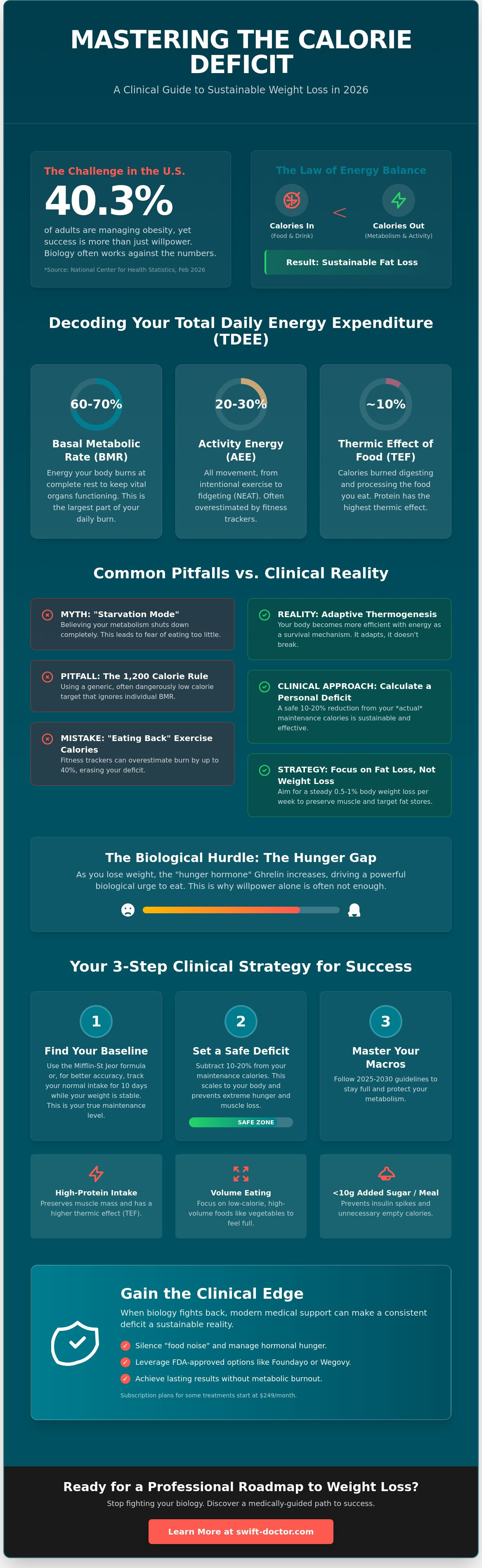
Many patients worry about "starvation mode," a common myth suggesting the metabolism completely shuts down during a diet. While your body does adapt to lower intake, it doesn't stop burning energy. Instead, it engages in adaptive thermogenesis, a process where the body becomes more efficient at using the energy it has. This conservation is a survival mechanism, not a permanent metabolic "breakage." Understanding this distinction is vital for maintaining a professional, clinical perspective on your weight loss journey.
The Three Pillars of Energy Expenditure
Your Total Daily Energy Expenditure (TDEE) is the sum of three distinct metabolic processes. The largest component is your Basal Metabolic Rate (BMR), which accounts for roughly 60 to 70% of your daily burn. This represents the energy your organs require to keep you alive while at rest. The second pillar is the Thermic Effect of Food (TEF), the energy used to digest and process nutrients. Finally, Activity Energy Expenditure (AEE) includes both intentional exercise and Non-Exercise Activity Thermogenesis (NEAT), such as walking to your car or even fidgeting. Balancing these three pillars is the key to a sustainable calorie deficit.
Fat Loss vs. Weight Loss
It's easy to confuse scale weight with actual fat loss. Your weight can fluctuate by several pounds in a single day due to water retention, inflammation, or glycogen stores. For every gram of carbohydrate stored as glycogen, your body holds approximately 3 to 4 grams of water. Rapid initial weight loss is often just the depletion of these stores. A clinical approach focuses on a moderate calorie deficit to ensure the weight lost comes from adipose tissue rather than lean muscle. Preserving muscle mass is essential because muscle is metabolically active; it helps maintain your BMR even as you lose weight. Aiming for a steady loss of 0.5% to 1% of body weight per week is the gold standard for long term health.
Calculating Your Personal Deficit for 2026
Calculating a calorie deficit is often where well-intentioned weight loss plans stall. The common "1,200 calorie rule" often does more harm than good. For many adults, this number is lower than their Basal Metabolic Rate, which can lead to fatigue, nutrient deficiencies, and the metabolic adaptation discussed in the previous section. A clinical approach focuses on precision rather than arbitrary restriction. It's about finding the "Goldilocks Zone," a deficit large enough to trigger fat loss but small enough to prevent muscle wasting and intense hunger.
One of the biggest pitfalls in 2026 remains the overestimation of activity. Research indicates that popular wearable devices can overestimate calories burned during exercise by as much as 40%. if you "eat back" these estimated calories, you'll likely erase your progress. Instead, treat exercise as a bonus for cardiovascular health rather than a license to increase intake. A professional strategy relies on consistent data rather than the fluctuating numbers on a fitness tracker.
Finding Your Maintenance Baseline
Your journey starts with finding your maintenance calories, the amount of energy you need to stay exactly where you are. Formulas like the Mifflin-St Jeor equation provide a reliable scientific estimate based on your age, sex, height, and weight. However, real-world data is superior. The "10-Day Tracking" method involves logging your normal food intake and weight daily for 10 days. If your weight stays stable, your average daily intake is your true maintenance baseline. As you lose weight, your maintenance level will naturally drop because a smaller body requires less energy. Periodic adjustments are necessary to avoid plateaus.
Setting Your Target Deficit
Once you have your baseline, we recommend a 10% to 20% reduction from your maintenance calories. This percentage-based approach is safer than a flat 500-calorie cut because it scales to your body size. Following how to calculate your calorie deficit correctly ensures you stay within the UK clinical guideline of losing 0.5kg to 1kg per week. If you're managing underlying conditions like Type 2 diabetes or hypertension, a professional medical consultation is essential before starting any new dietary protocol. This ensures your nutrition plan supports your overall health while you move toward your weight goals.
Why Calorie Deficits Fail: The Hunger Gap
Most weight loss journeys stall not because of a lack of discipline, but because of a biological "hunger gap." When you maintain a calorie deficit, your body doesn't see a goal; it sees a threat to its survival. This triggers metabolic adaptation, a process where your system reduces its energy output to match the lower input. Your heart rate might slightly slow, your body temperature may drop, and you'll subconsciously move less throughout the day. This is why the same amount of food that caused weight loss in month one might only result in maintenance by month three.
The "Willpower Trap" is the belief that you can simply ignore these signals indefinitely. As your fat stores decrease, your brain increases the production of ghrelin, the hormone responsible for signaling hunger. Simultaneously, it decreases leptin, the hormone that tells you you're full. This hormonal shift creates a constant mental preoccupation with food, often called "food noise." Clinical data suggests that biological signals eventually override mental discipline in 95% of cases without a structured, medically informed approach. It's a fight against your own evolutionary programming.
The Survival Mechanism Explained
Your body protects its energy stores during what it perceives as a famine. As you get leaner, the drop in leptin makes you feel less satisfied even after eating a nutritious meal. This is often when "cheat meals" become dangerous. A single high calorie day can easily erase a week's worth of progress. If you've maintained a 500 calorie daily deficit from Monday to Friday, a 2,500 calorie surplus on Saturday completely resets your net energy balance to zero. Consistency is more important than perfection.
Overcoming Plateaus
Plateaus are a natural part of the clinical weight loss process. One common phenomenon is the "Whoosh Effect," where fat cells temporarily fill with water after they've been emptied of triglycerides. This can mask fat loss on the scale for weeks until the body finally releases the fluid. To manage this, many clinicians now recommend a "Diet Break" every 8 to 12 weeks. Spending 7 days eating at your maintenance calories can help reset thyroid hormones and leptin levels, making it easier to return to a calorie deficit afterward. Precision is also vital; weighing your food instead of estimating portions can reveal hidden calories in oils and dressings that often account for a 20% error in self-reported intake.
Sustainable Strategies to Maintain a Deficit
Sustainable weight loss requires more than just math; it requires a strategy that manages your body's biological pushback. Maintaining a calorie deficit becomes significantly easier when you prioritize "protein sparing." Consuming adequate protein, as emphasized in the 2025-2030 Dietary Guidelines for Americans, ensures your body repairs tissue rather than breaking down muscle for energy. This keeps your metabolic rate higher over time. Protein also has a higher thermic effect, meaning your body burns more energy simply processing it compared to fats or carbohydrates.
Volume eating is another clinical tool. By choosing foods with low caloric density but high water and fibre content, such as leafy greens or cruciferous vegetables, you can physically stretch the stomach lining. This sends signals to the brain that you're full, even if the total energy intake is low. Additionally, focusing on Non-Exercise Activity Thermogenesis (NEAT) is often more effective for long-term adherence than high-intensity gym sessions. A consistent 10,000 steps per day provides a steady burn without the extreme hunger spikes often triggered by intense cardio. It's about moving more, not just exercising harder.
Nutritional Priorities
Stabilising blood sugar is the key to avoiding the "hunger gap" mentioned earlier. High-fibre complex carbohydrates provide a slow release of energy, preventing the insulin spikes that lead to cravings. We also recommend the 80/20 rule: 80% whole, minimally processed foods and 20% flexible choices. This prevents the psychological burnout that leads to binge cycles. Hydration plays a silent role here too. The brain often processes thirst signals in the same region as hunger; drinking 500ml of water when a craving hits can often reveal that you weren't actually hungry. Chronic stress and lack of sleep (less than 7 hours) can also elevate cortisol, making it much harder to stay in a calorie deficit.
Exercise for Maintenance, Not Just Deficit
While a deficit drives weight loss, resistance training preserves the engine. Lifting weights two to three times a week signals the body to keep its muscle mass, which prevents the metabolic slowdown common in rapid weight loss. Don't rely on the "afterburn effect" or EPOC. While real, it usually only accounts for an extra 6% to 15% of the total calories burned during the session, which is easily erased by a single small snack. Focus on consistency and movement that you enjoy. If you're finding the biological drive to eat is becoming unmanageable despite these strategies, you can book a professional consultation to discuss clinical options that help bridge the hunger gap.
The Clinical Edge: How Medical Support Simplifies the Deficit
The science of weight loss has fundamentally shifted with the introduction of GLP-1 and GIP receptor agonists. While a calorie deficit remains the biological requirement for fat loss, medical support addresses the hormonal imbalances that make that deficit feel impossible. Medications like Mounjaro or the oral medication Foundayo, which received FDA approval in April 2026, help bridge the "hunger gap" by regulating the signals between your gut and brain. This isn't a shortcut or a replacement for healthy habits. It's a clinical tool that levels the playing field against your own biology.
For many patients, the most transformative benefit is the silencing of "food noise." This term describes the constant, intrusive thoughts about the next meal or the persistent cravings that usually derail even the best-planned diets. When these signals are quieted, the psychological burden of restriction vanishes. You're no longer fighting an hourly battle of willpower. Instead, you're empowered to make rational nutritional choices that align with your long-term health goals without the mental exhaustion of constant hunger.
How GLP-1 Medications Work
These medications function through two primary physiological pathways. First, they slow gastric emptying. This means food stays in your stomach longer, allowing you to feel physically full after eating significantly smaller portions. Second, they target the appetite centers of the brain. By reducing the reward-seeking drive for high-calorie foods, they lower the urge for "hedonic eating." Data from the National Health and Nutrition Examination Survey released in February 2026 shows that medically supervised plans lead to significantly higher adherence rates compared to dieting alone. Medication supports a calorie deficit by making the required reduction in intake feel natural rather than forced.
Your Journey with SwiftDoctor
At Swift Doctor, we prioritize your safety and long-term success through a modern, service-oriented approach. Every patient begins with a thorough consultation with a GMC-registered doctor to ensure any treatment is clinically appropriate for their specific medical history. We don't just provide a prescription; we help you develop a comprehensive plan that integrates medical support with the nutritional and movement strategies discussed earlier. This partnership ensures you lose weight safely while maintaining your metabolic health. If you're ready to move past the cycle of constant hunger and plateaus, you can consult with a SwiftDoctor clinician to see if medical weight management is right for you. We provide the professional expertise you need in the comfort of your own home.
Your Clinical Path to Sustainable Weight Loss
Mastering a calorie deficit is no longer a matter of sheer willpower. By understanding the biological mechanics of energy expenditure and the hormonal drivers of hunger, you can move away from the cycle of restrictive dieting and plateaus. Modern clinical advancements in 2026 have proven that weight management is most effective when medical support addresses the survival mechanisms that often derail progress. Whether you're navigating metabolic adaptation or struggling with persistent food noise, a structured approach ensures your body works with you, not against you.
At Swift Doctor, we combine professional expertise with the convenience of modern healthcare. Our team of GMC-registered doctors and our GPhC-registered pharmacy specialize in Mounjaro and Wegovy treatments, providing a safe and regulated environment for your journey. You don't have to navigate these physiological challenges alone. Take the first step toward a healthier future and start your medical weight loss consultation with SwiftDoctor today. With the right clinical tools and expert guidance, sustainable weight loss is within your reach.
Frequently Asked Questions
Can I build muscle while in a calorie deficit?
Yes, you can build muscle while in a calorie deficit through a process known as body recomposition. This requires a high protein intake, typically between 1.6 and 2.2 grams per kilogram of body weight, combined with consistent resistance training. While the rate of muscle growth is usually slower than it would be in a caloric surplus, providing the physical stimulus through weightlifting signals your body to prioritize fat stores for energy while using dietary protein for tissue repair.
Why am I not losing weight even though I’m in a deficit?
You are likely either experiencing temporary water retention or underestimating your actual caloric intake. Clinical studies show that individuals often underestimate their food consumption by 20% to 30%, even when they are diligently tracking. Hidden calories in cooking oils, sauces, or weekend meals can easily erase a weekday deficit. Additionally, the "Whoosh Effect" can cause water to mask fat loss on the scale for several weeks before a sudden drop occurs.
Is a 1,200-calorie diet safe for everyone?
No, a 1,200-calorie diet is not universally safe or effective for most adults. For many people, this level of restriction falls below their Basal Metabolic Rate (BMR), which can lead to severe fatigue, hair loss, and the formation of gallstones. It is rarely sustainable for active individuals or those with higher starting weights. A clinical approach focuses on a 10% to 20% reduction from your specific maintenance level rather than adhering to an arbitrary, low-calorie floor.
How do I know if my calorie deficit is too large?
You will experience symptoms like extreme lethargy, constant coldness, poor sleep quality, and a noticeable drop in cognitive function if your calorie deficit is too aggressive. For women, the loss of a menstrual cycle is a critical warning sign of low energy availability. if you're losing more than 1% of your total body weight per week on a consistent basis, you're likely at a higher risk for muscle wasting and metabolic slowdown.
Do I still need a calorie deficit if I am taking Mounjaro or Wegovy?
Yes, a deficit is still the fundamental requirement for weight loss while using GLP-1 medications. These treatments work by suppressing appetite and slowing digestion, which makes it much easier for you to consume fewer calories without the intense hunger signals typically associated with dieting. The medication manages the biological "hunger gap" and "food noise," but the actual fat loss still occurs because your body is consuming less energy than it burns daily.
What happens to my metabolism if I stay in a deficit for too long?
Your metabolism undergoes adaptive thermogenesis, where the body becomes more efficient and burns fewer calories to perform the same daily tasks. This is a survival mechanism designed to prevent starvation. If a deficit is maintained for several months without breaks, your BMR can drop significantly. This is why we recommend "diet breaks" or maintenance phases every 8 to 12 weeks to help normalize hormone levels and prevent a permanent metabolic slowdown.
Can I lose weight without exercising if I’m in a deficit?
Yes, you can lose weight without exercise as long as you maintain a consistent calorie deficit. Weight loss is primarily driven by nutritional intake and the energy gap you create through food choices. However, without resistance training, a larger percentage of the weight lost will come from lean muscle tissue rather than fat. This can lead to a lower metabolic rate over time, making it harder to maintain your new weight in the long term.
How do I calculate my deficit if I have a sedentary job?
You should use the Mifflin-St Jeor formula and apply a "Sedentary" activity multiplier, which is typically 1.2. This multiplier accounts for the energy used for basic daily tasks but excludes significant exercise. For a person working a desk job, your Total Daily Energy Expenditure (TDEE) will be closer to your BMR. It's safer to calculate your deficit based on this lower number to ensure you aren't overestimating your daily burn through movement.
This guide is for general information and isn't a substitute for personal medical advice. If you're unsure whether a treatment is right for you, speak to a clinician.
Want to talk it through?
Book a private GP appointment at a time that suits you.
Book a GP appointmentKeep reading