The Ultimate UK Calorie Calculator: Understanding Your Daily Energy Needs in 2026
The most effective way to lose weight isn't to eat as little as possible; it's to eat exactly what your body requires to function while maintaining a controlled deficit. According to the latest Health Survey for England,…

In this guide
The most effective way to lose weight isn't to eat as little as possible; it's to eat exactly what your body requires to function while maintaining a controlled deficit. According to the latest Health Survey for England, 64% of adults are currently classified as overweight or obese, yet many struggle to see results because they're simply guessing their daily intake. Using a precise calorie calculator tailored to UK lifestyle factors removes this uncertainty and provides a roadmap based on clinical biology rather than hope.
It's exhausting to deal with constant hunger or the frustration of weight loss plateaus that seem to defy logic. You might find terms like BMR and TDEE confusing, making the process feel unnecessarily complicated. This guide will help you master the science of calorie counting to discover your personal energy requirements for sustainable weight management. You'll gain a clear daily calorie target, understand how your activity levels impact your specific number, and learn exactly when it's appropriate to seek professional medical support to ensure your health remains the priority.
Key Takeaways
- Understand the fundamental principle of energy balance and how calories function as the essential fuel your body requires for daily activity.
- Discover how to use a professional calorie calculator to determine your Basal Metabolic Rate (BMR) based on the clinically recognised Mifflin-St Jeor Equation.
- Learn why weight management is a biological challenge, specifically how the hormones Ghrelin and Leptin influence your hunger and satiety levels.
- Master the art of lifestyle organisation by calculating your TDEE and applying a sustainable 10-20% deficit for realistic results.
- Identify when standard methods may fall short and how professional clinical solutions can provide the medically overseen support required for lasting results.
What is a Calorie Calculator and Why is it Essential for Weight Management?
A calorie is simply a unit of heat energy. In the context of human biology, it represents the fuel your body requires to perform every internal process, from cellular repair to cognitive function. Understanding the science of food energy is the first step toward regaining control over your health. Your body operates on a principle of energy balance. If you consume more energy than you expend, the surplus is stored as adipose tissue. Conversely, a deficit forces the body to utilise its stored energy, leading to weight loss.
Using a calorie calculator shifts your approach from "blind dieting" to a precise, data-driven strategy. Many people fail in their health journeys because they rely on vague estimations or restrictive fads that don't account for their specific metabolic needs. A calculator provides a baseline that respects your bio-individuality. One person’s maintenance level might be another person’s significant surplus, depending on their unique physiological makeup and daily habits.
The Difference Between BMR and TDEE
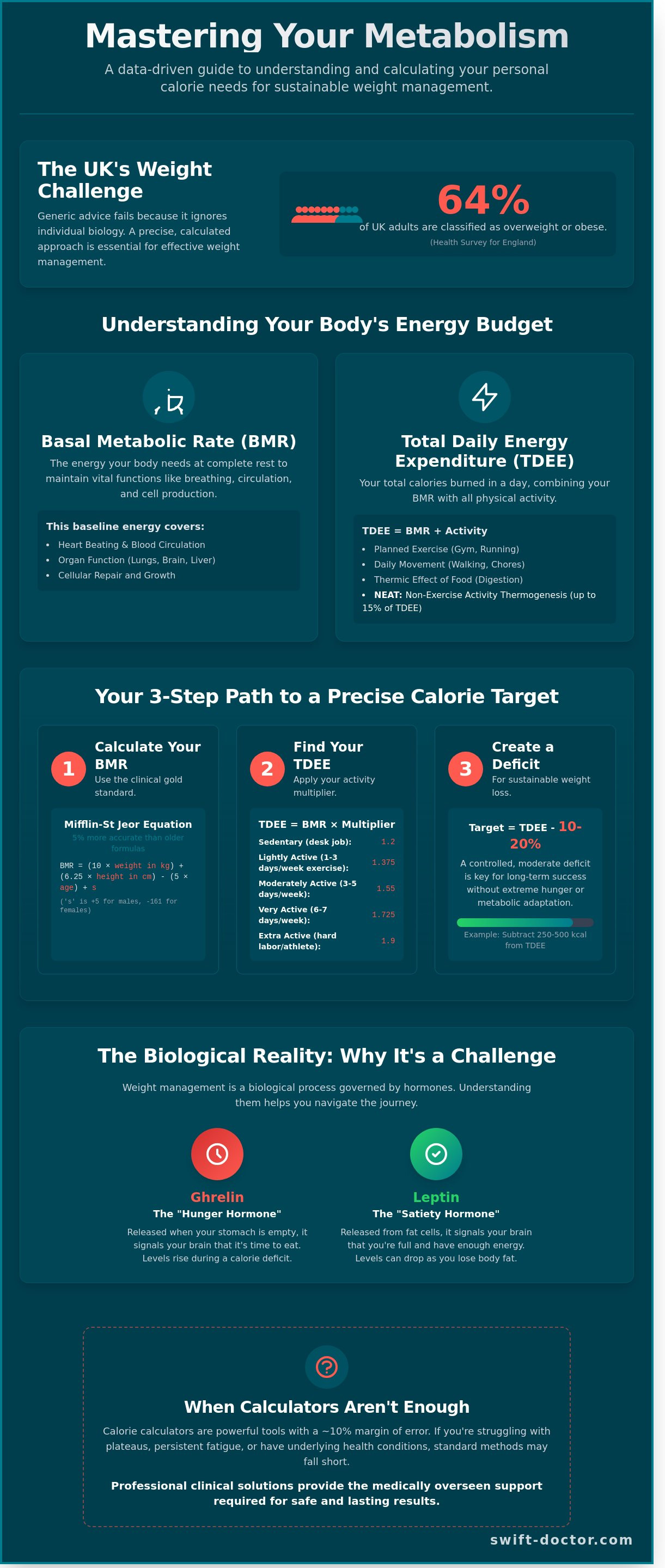
Basal Metabolic Rate (BMR) represents the energy your body needs to maintain basic life functions while at rest. It covers the "cost" of keeping your heart beating and your organs functioning. Total Daily Energy Expenditure (TDEE) is a more comprehensive figure. It combines your BMR with the energy used during exercise and daily movement. A vital component of TDEE is Non-Exercise Activity Thermogenesis (NEAT), which includes incidental movements like walking to the station or gardening. NEAT can account for up to 15% of your total daily burn, making it a powerful tool for weight management that often goes overlooked.
Why "One Size Fits All" Diets Fail the British Public
The standard UK guidelines of 2,000 kcal for women and 2,500 kcal for men are broad population averages, not personalised prescriptions. These figures don't account for the fact that a 65-year-old retiree has vastly different metabolic requirements than a 25-year-old athlete. Factors such as height, biological sex, and muscle mass significantly alter how your body processes energy. A calorie calculator allows for the precision required in modern health management. You must also remember to recalculate your needs regularly. As you lose weight, your body requires less energy to move and maintain itself, meaning a "deficit" target from three months ago might now be your new maintenance level.
The Science of Calculation: How Your Daily Needs are Determined
The Mifflin-St Jeor Equation stands as the current clinical gold standard for estimating Basal Metabolic Rate (BMR) in healthy adults. This formula relies on three primary biological variables: weight in kilograms, height in centimetres, and age in years. Most modern calorie calculator tools use these specific metrics to establish the baseline energy required to maintain vital organ function while at rest. It's the most reliable starting point for anyone looking to manage their weight with scientific precision.
Establishing your BMR is only the foundation of the process. To find your Total Daily Energy Expenditure (TDEE), you must apply an "Activity Multiplier." This numerical factor scales your BMR based on physical exertion, ranging from 1.2 for sedentary lifestyles to 1.9 for elite athletes or manual labourers. For those with access to body composition data, the Katch-McArdle formula provides a more tailored result. By using lean body mass instead of total weight, it avoids the inaccuracies that occur when calculating your daily calorie needs for individuals with high muscle density or specific athletic goals.
Mifflin-St Jeor vs. Harris-Benedict
While the Harris-Benedict equation was the pioneer in 1919, it often overestimates energy needs in modern, less active populations. Research from 2005 indicates that the Mifflin-St Jeor model is 5% more accurate, particularly for individuals classified as overweight. It's vital to remember that these are mathematical predictions, not absolute certainties. Most calculators have a margin of error of approximately 10%. If you're struggling with persistent fatigue or a plateaued weight loss journey, a discreet medical consultation can ensure your metabolic health is functioning correctly.
The Role of Thermic Effect of Food (TEF)
The energy used to digest, absorb, and process nutrients is called the Thermic Effect of Food (TEF), and it accounts for about 10% of your total daily expenditure. Different macronutrients require different amounts of energy to break down. Protein has the highest TEF, requiring up to 30% of its calories for processing, whereas fats only require 3%. You can naturally increase your metabolic output by prioritising lean proteins and high-fibre vegetables. These foods demand more "digestive work" than processed snacks, helping you stay satiated while your body burns more energy during the post-meal period.
To get the most out of your calorie calculator, consider these practical tips for digestive efficiency:
- Swap refined grains for wholewheat versions to increase fibre intake.
- Include a source of lean protein, such as chicken or lentils, in every meal.
- Stay hydrated, as water is essential for the chemical reactions involved in TEF.
Calorie Deficits and the Biological Reality of Hunger
Many people assume that once they use a calorie calculator, the path to weight loss is a simple matter of willpower. It isn't. Your body views a sustained energy deficit as a threat to survival. This triggers a complex hormonal response designed to force you back to your previous weight. Ghrelin, often called the "hunger hormone," increases significantly during a deficit, while Leptin, which signals fullness, tends to drop. This creates a biological "hunger gap" that makes "just eating less" feel like an uphill battle rather than a simple choice.
Your body also adapts by becoming more efficient. This process, known as metabolic adaptation, can reduce your resting energy expenditure by up to 15% in some cases. To avoid triggering a severe metabolic slowdown, health professionals generally recommend a "safe" deficit of 500 calories per day. This target typically leads to a manageable weight loss of 0.5kg per week. This pace preserves muscle mass better than aggressive fasting and helps keep the body's defensive hunger signals at a lower intensity.
When the Calculator Meets Reality
Weight loss is rarely a straight line. You might follow your calorie calculator targets perfectly for seven days and see the scale go up. This is often due to water retention caused by cortisol, the stress hormone, or inflammation from a new exercise routine. A true plateau is defined as no change in weight or measurements for at least four consecutive weeks. Short-term fluctuations are usually just shifts in hydration, glycogen storage, or sleep quality rather than a failure of the deficit itself. Consistency matters more than daily precision.
The "Hunger Gap" and Medical Support
For many, the biological drive to eat eventually overrides even the most disciplined tracking. This is where modern medicine offers a bridge. GLP-1 medications, such as Mounjaro or Wegovy, work by mimicking natural hormones to suppress appetite and slow gastric emptying. These aren't "shortcuts." They are evidence-based tools that help patients close the hunger gap, making it physically possible to adhere to a calorie deficit without constant distress.
If you're struggling despite accurate tracking, exploring clinical weight loss solutions under professional supervision can provide the necessary support. Clinical oversight ensures these treatments are used safely as part of a comprehensive health plan. At Swift Doctor, we believe that medical support should be accessible and discreet, helping you manage the biological realities of weight loss with expert guidance and modern therapeutic options.
How to Organise Your Lifestyle Around Your Calorie Target
Once you've established your baseline energy requirements using a reliable calorie calculator, the focus shifts to practical application. Many people make the mistake of slashing their intake by a flat 500 or 1,000 calories immediately. This often leads to burnout and muscle loss. Research from the British Journal of Nutrition suggests that a sustainable deficit of 10-20% is far more effective for long-term adherence. For an average adult with a TDEE of 2,500kcal, this means aiming for a modest reduction to 2,000 or 2,250kcal. This approach preserves your metabolic rate while allowing for consistent fat loss.
Nutrition quality is just as vital as the quantity. You should prioritise 1.6g to 2.2g of protein per kilogram of body weight to protect lean tissue. Additionally, the NHS recommends 30g of fibre daily. Fibre is your best tool for satiety, as it slows digestion and prevents the hunger spikes that lead to snacking. Don't change your targets too quickly. It's essential to track your progress for 14 to 21 days before making any adjustments. This period allows your body to stabilise and provides a clear data set. Complement your nutrition with resistance training at least twice a week. Lifting weights ensures that the weight you lose comes from fat stores rather than functional muscle.
Smart Tracking: Tools and Techniques
Precision is the difference between success and frustration. While apps like MyFitnessPal are popular, UK users often find Nutracheck more useful because it features a more comprehensive database of British supermarket brands and chain restaurants. You must weigh your food using digital scales. A study in the Journal of Human Nutrition and Dietetics found that "eyeballing" portions leads to underestimating intake by roughly 37%. Be mindful of hidden calories; a single tablespoon of olive oil adds 120kcal to a meal. When dining out, look for calorie counts on menus, which is now a legal requirement for UK businesses with more than 250 employees.
The "Small Wins" Strategy
Daily perfection is an unrealistic goal. Focus on your weekly average instead. If your target is 2,000kcal a day, you have a weekly budget of 14,000kcal. You can use "calorie banking" by eating 1,800kcal on weekdays to save an extra 1,000kcal for a Sunday roast or a social event. This flexibility prevents the "all-or-nothing" mindset that ruins most diets. Celebrate non-scale victories, such as improved sleep quality or needing a smaller belt notch. These indicators often signal physiological progress before the scale reflects a change. If you need professional support to manage your weight and overall health, book a private GP consultation for expert medical advice tailored to your needs.
When Calories Aren’t Enough: Exploring Clinical Weight Loss Solutions
While a calorie calculator provides a vital roadmap for weight management, it doesn't account for every biological hurdle. Many people find that despite strictly following their calculated targets, weight loss remains elusive. This often happens because obesity is a chronic medical condition rather than a simple lack of willpower. Statistics from the Health Survey for England 2022 show that 25.9% of adults in England are living with obesity. For this group, clinical intervention often becomes the necessary next step to achieve sustainable health outcomes.
SwiftDoctor offers a professional pathway for those who need more than just tracking. Our service connects you with GMC-registered doctors who oversee your weight loss journey. Every treatment plan is fulfilled by GPhC-regulated pharmacies, ensuring you receive authentic, safe medication. We prioritise your safety through rigorous protocols, moving weight management from a solo effort to a medically supervised programme. This professional oversight is essential when dealing with the metabolic complexities that a digital tool cannot solve on its own.
The SwiftDoctor Consultation Process
Accessing clinical weight loss solutions shouldn't be a bureaucratic struggle. Our online medical review determines your eligibility for advanced treatments like Mounjaro or Wegovy. You'll complete a comprehensive health questionnaire that our clinical team reviews to ensure the medication is safe for your specific profile. Once approved, we provide discreet, national UK delivery. You won't just receive a prescription; you'll gain access to ongoing safety monitoring and support from our medical professionals. This continuous care helps manage side effects and ensures your dosage remains optimal for your progress. Our goal is to provide the convenience of an online service with the rigour of a traditional clinic.
Taking the First Step Toward a Healthier Weight
Your calorie calculator results serve as a perfect baseline for a deeper medical conversation. If your BMI is 30 or higher, or 27 with weight-related health issues like hypertension or type 2 diabetes, medical support is a logical progression. We view weight management through a clinical lens, acknowledging that hormonal signals often override calorie counting alone. Obesity is a complex medical condition, not a character flaw, and it deserves a medical solution. You can start your medical consultation for weight loss today and move beyond the limitations of simple tracking. Taking this step means choosing a regulated, safe, and medically backed approach to your long-term health. It's time to treat your weight with the same clinical seriousness as any other health condition.
Taking Control of Your Weight Management Journey
Mastering your body composition in 2026 starts with precise data. A professional calorie calculator gives you the essential baseline, but the real challenge lies in managing the biological hunger signals that naturally follow a sustained energy deficit. While tracking intake is a vital skill, it's often the physiological response to weight loss that halts progress for many people across the UK.
When lifestyle adjustments aren't enough to overcome these internal hurdles, clinical support provides a structured and medically backed alternative. At SwiftDoctor, we bridge the gap between metabolic science and your daily reality. Our service is overseen by GMC-registered doctors and all medications are dispensed by GPhC-registered UK pharmacies. We prioritise your privacy with discreet national delivery, bringing professional care directly to your door. It's time to move past the frustration of stalled progress and embrace a solution that works with your biology. Check your eligibility for medical weight loss treatment at SwiftDoctor and take a confident step toward your health goals today.
Frequently Asked Questions
How many calories should I eat to lose 2lbs a week?
To lose 2lbs per week, you generally need a daily deficit of 1,000 calories. This target is ambitious and often difficult to sustain safely without medical supervision. For a 35-year-old woman of average height, this might mean dropping below 1,200 calories, which increases the risk of nutritional deficiencies. Most UK health guidelines, including NHS recommendations, suggest a slower rate of 0.5kg to 1kg per week for long-term success.
Is a 1200 calorie diet safe for everyone?
No, a 1200 calorie diet isn't safe or appropriate for everyone. While it's often cited as a minimum for women, it typically fails to meet the energy requirements of men, active individuals, or those with higher body masses. Consuming too few calories can lead to gallstones, heart arrhythmias, and extreme fatigue. Our calorie calculator helps identify a safer, personalised floor based on your specific Basal Metabolic Rate (BMR) and activity levels.
Does the calorie calculator take exercise into account?
Yes, the calorie calculator uses the Mifflin-St Jeor equation combined with a Physical Activity Level (PAL) multiplier to account for exercise. This multiplier ranges from 1.2 for sedentary lifestyles to 1.9 for elite athletes or heavy manual workers. By selecting your activity frequency, the tool adjusts your Total Daily Energy Expenditure (TDEE) to ensure you aren't under-fuelling during workouts. This precision prevents the metabolic slowdown often caused by excessive calorie restriction.
Why am I not losing weight even though I am in a calorie deficit?
Metabolic adaptation or "starvation mode" can cause weight loss to stall if your deficit is too aggressive for more than 12 weeks. Water retention caused by high cortisol levels or increased sodium intake also masks fat loss on the scales. Research shows that 40% of people underestimate their calorie intake by at least 300 calories daily. Ensure you're weighing portions rather than estimating them to maintain an accurate deficit.
Can I calculate my calories if I have a medical condition like PCOS?
You can calculate a baseline, but conditions like Polycystic Ovary Syndrome (PCOS) often lower your BMR by up to 400 calories compared to those without the condition. Insulin resistance makes traditional calculations less reliable. If you're managing PCOS or hypothyroidism, use the calculator as a starting point then consult a GP. We provide professional medical consultations to help tailor your nutrition to your specific hormonal profile.
What happens if I eat fewer calories than my BMR?
Eating below your BMR forces your body to break down muscle tissue and organ mass for energy. This practice slows your metabolism and can lead to hair loss, brittle nails, and a weakened immune system. Your BMR represents the energy needed for vital functions like breathing and heart rate at rest. Consistently dipping below this number is medically discouraged as it compromises your long-term health and metabolic recovery.
How often should I update my calorie targets?
You should update your calorie targets every time you lose 5kg to 7kg of body weight. As you get smaller, your body requires less energy to function and move, meaning your old deficit might now be your new maintenance level. Recalculating your needs once a month ensures your targets remain accurate. This proactive approach prevents the common plateaus that occur during a long-term weight loss journey.
Do calories from protein count the same as calories from fat?
While all calories provide energy, your body processes them differently. Protein contains 4 calories per gram, while fat contains 9 calories per gram. Protein has a higher Thermic Effect of Food (TEF), meaning you burn about 20% to 30% of its energy just during digestion. In contrast, you only burn 0% to 3% of fat calories during processing. Choosing high-protein options can help you feel fuller for longer.
This guide is for general information and isn't a substitute for personal medical advice. If you're unsure whether a treatment is right for you, speak to a clinician.
Want to talk it through?
Book a private GP appointment at a time that suits you.
Book a GP appointmentKeep reading